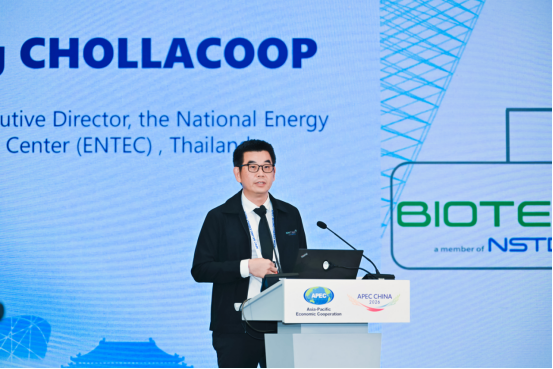
Exclusive 丨 Balancing Progress and Prudence: Thailand’s Approach to Energy Transition
— An Interview with Dr. Nuwong CHOLLACOOP, Acting Deputy Executive Director, the National Energy Technology Center (ENTEC), Thailand
Within the APEC framework for regional energy cooperation, emerging market economies in Southeast Asia, represented by Thailand, are rapidly scaling up renewable energy such as photovoltaic power. Nevertheless, practical challenges including insufficient grid flexibility and the orderly retirement of conventional power sources have directly constrained the on-the-ground delivery of energy transition outcomes. Aligning technology deployment, institutional coordination and financing capacity remains a tangible challenge for developing economies across the region.
On this topic, reporters from China Energy Media Group conducted an exclusive interview with Dr. Nuwong CHOLLACOOP, Acting Deputy Executive Director of Thailand’s National Energy Technology Center. Addressing practical pain points in transition implementation, he shared Thailand’s practices and experience in the green energy transition, offering first-hand industry insights for APEC members to advance pragmatic energy cooperation.
China Energy Media Group:Thailand is vigorously developing solar photovoltaic, floating photovoltaic and other new energy sources, targeting a substantial increase in the share of renewable energy power generation. Nevertheless, it is confronted with practical challenges including insufficient grid flexibility and heavy pressure in supporting energy storage deployment amid high-penetration new energy integration. Drawing on research and practical experience from Thailand’s National Energy Technology Center, what do you identify as the core technical bottlenecks and institutional barriers for Thailand in building a new-type power system compatible with high shares of renewable energy? What practical lessons can other developing APEC economies learn from Thailand’s experience?
Nuwong CHOLLACOOP: In my opinion, Thailand needs to overcome institutional barriers in communication among state enterprise utilities, especially on grid code interoperability, in order to accommodate high shares of renewable energy from private sectors without losing grid stability, with help from commercially available cutting-edge technical solutions. The practical lesson Thailand offers to other developing APEC economies is institutional alignment paired with appropriate technical solutions.
China Energy Media Group:APEC member economies differ widely in resource endowments and power-sector fundamentals, with divergent energy transition timelines between advanced economies and developing Southeast Asian economies. As a key emerging economy in the Asia-Pacific, based on Thailand’s engagement in the APEC Energy Working Group, in your view, what constitutes the most critical gap that APEC needs to address to advance regional energy transition cooperation: technology sharing, financial support, or capacity-building? What priority practical cooperation initiatives does Thailand wish to pursue with fellow APEC members in areas such as energy storage, new energy grid integration and grid modernization?
Nuwong CHOLLACOOP: In my opinion, the most critical gap to advance regional energy transition cooperation among APEC economies is win-win cooperation for technology transfer from more advanced economies to emerging economies, backed by reasonable financial support and capacity-building to sustain transferred technologies in recipient economies. Thailand is learning from more advanced economies on integrating energy storage into the grid to accommodate new energy toward grid modernization.
China Energy Media Group:While scaling up new energy deployment, Thailand also needs to reconcile power-sector affordability and energy security. From Thailand’s on-the-ground experience, how can the country strike a sound balance between phasing out conventional power sources, large-scale new energy expansion, and secure power supply? What insights does this offer for other Asia-Pacific economies grappling with energy structure transition pressures?
Nuwong CHOLLACOOP: The overarching principles for Thailand’s energy plan follow the security-economy-ecology triangle toward decentralization and a just energy transition. Thailand tries to balance phasing out conventional power sources, expanding large-scale new energy, and securing power supply through its Power Development Plan. The plan sets targets to scale up clean energy such as solar, wind, BESS (Battery Energy Storage System), and SMR (Small Modular Reactor), alongside an appropriate mix of CCGT (Combined Cycle Gas Turbine) and CCUS (Carbon Capture, Utilization, and Storage), if needed, to achieve its 2050 Net Zero Target. The insight for other APEC economies is to pursue locally appropriate clean energy mixes through the lens of a just energy transition.(By Zhang Dongjun, Wang Xuecong, China Energy Media Group)